- The Things I've Seen
- Posts
- TIS-013 - The Mimms Museum - iNSPIRE exhibit
TIS-013 - The Mimms Museum - iNSPIRE exhibit

Lou Manglass
April 01, 2026
The Things I’ve Seen
“I did not tell half of what I saw, for I knew I would not be believed.” - Marco Polo on his deathbed, 1324, apparently? Uncharted said so.
“I have discovered a truly marvelous proof of this, which this margin is too narrow to contain.” Pierre de Fermat, though that was about maths.
I needed a reset - I have neither found nor made the time I need to write lately. The Hales Bar Dam work has been a lot more of a load than I thought it would be, and I keep going back to the well, so to speak, to find more information. I keep finding side quests and throwing them out. Ultimately this is a me problem: the intent I have is for these to be fun little jaunts through just some of the random things I get to see, reactions really, and four months later I’m still putting the pieces of a puzzle together for one of several things I saw on my trip.
Part 2 is still coming! It will only be a two-parter! I’m also taking a quick detour for something fresh on my mind. The Mimms Museum of Technology and Art in Roswell Georgia, formerly the Computer Museum of America, is preparing to open their newest exhibit iNSPIRE: 50 years of innovation from Apple. I got to see a preview today, and it officially opens to the public 1 April 2026. You’ll want to catch this if you’re in the area.
And of course, because it all goes together, there’s an easter egg in this article. We’ll end up back in the neighborhood of the Tennessee River Valley once more. Everything clicks together, perhaps a lesson to me. Perhaps trusting in the process a bit more is the way to go…all these random easter eggs will still turn up!
iNSPIRE
I wasn’t sure what to think of this exhibit when I first started. Was it going to be too deferential to Steve Jobs? Not really! Would it ignore Steve Wozniak? Not really! Would it include an Apple 1 like they said it would? Kinda. It sounds like I’m sandbagging a bit, because I came in with the completely incorrect expectations. The summary: this exhibit is a blast! Go check it out!
We’re coming up on the 50th anniversary1 of Apple. Steve Jobs sold his VW Bus and Steve Wozniak sold his HP-65 calculator to fund building boards for what would be basically a kit computer, the Apple 1. I know, it might seem silly to think of this as a fair partnership. However, programmable calculators in the 70s were big deals. It retailed in 1974 for $795, equivalent to about $5000 today2 . I’d love to get my hands on one of these and do a deep dive. I couldn’t find the vintage of Jobs’ bus or a fair valuation, but…that calculator carried some weight.
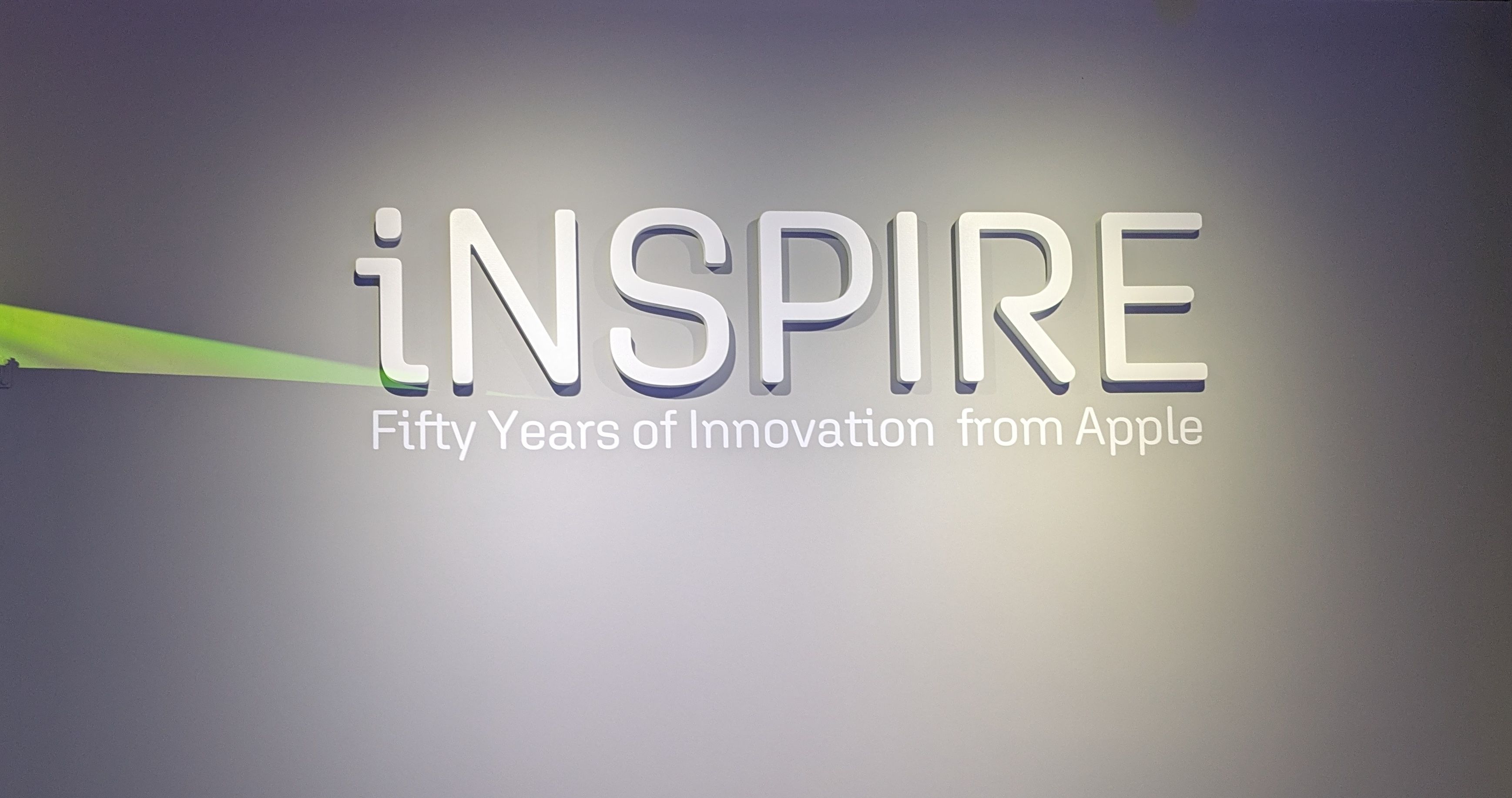 The iNSPIRE welcome wall Anyway, the Mimms Museum put together this exhibit to go through the history of Apple and put it in the context of its impact on the world. There’s some really cool history here, and a lot of space is given to the 70s and 80s which to me is definitely the most interesting era. We’re plunked solidly in the era of what people tend towards when they think of retrocomputing, and the exhibits don’t disappoint. | 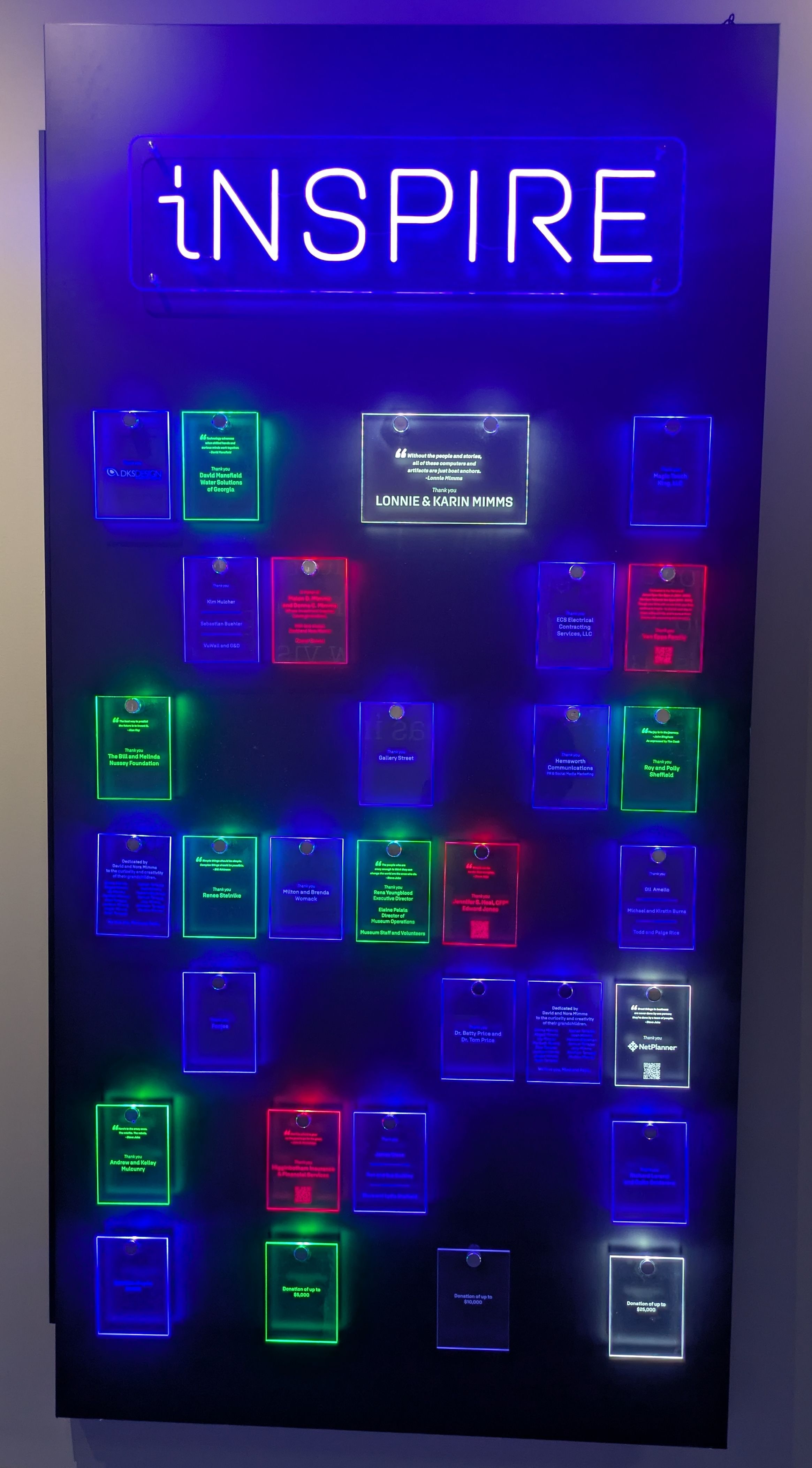 A display of donors who made iNSPIRE possible. |
Captain Crunch and the Blue Box
Before we even get to Apple, the exhibit goes through Steve, Steve, and some of the company’s early founding. They talk about other key figures, like Ronald Wayne (a short-termed executive) and Bill Fernandez (a friend who linked up the Steves because “they both liked pranks”). They also talked about the context of the time, like phone phreaking. Included in the exhibit is this Blue Box
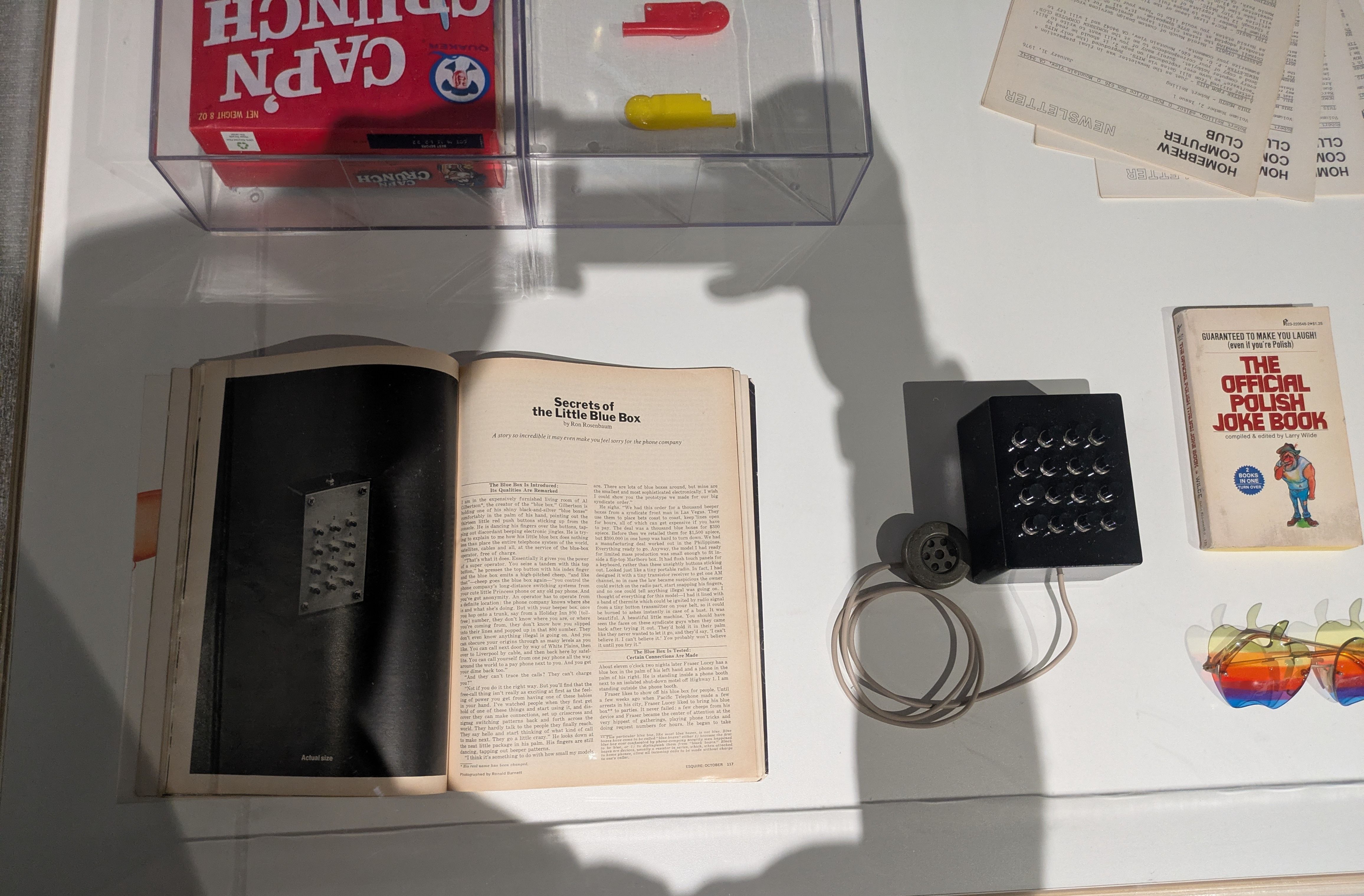 A blue box, hand built, next to an article and a book of Polish jokes like the one Wozniak would have read from 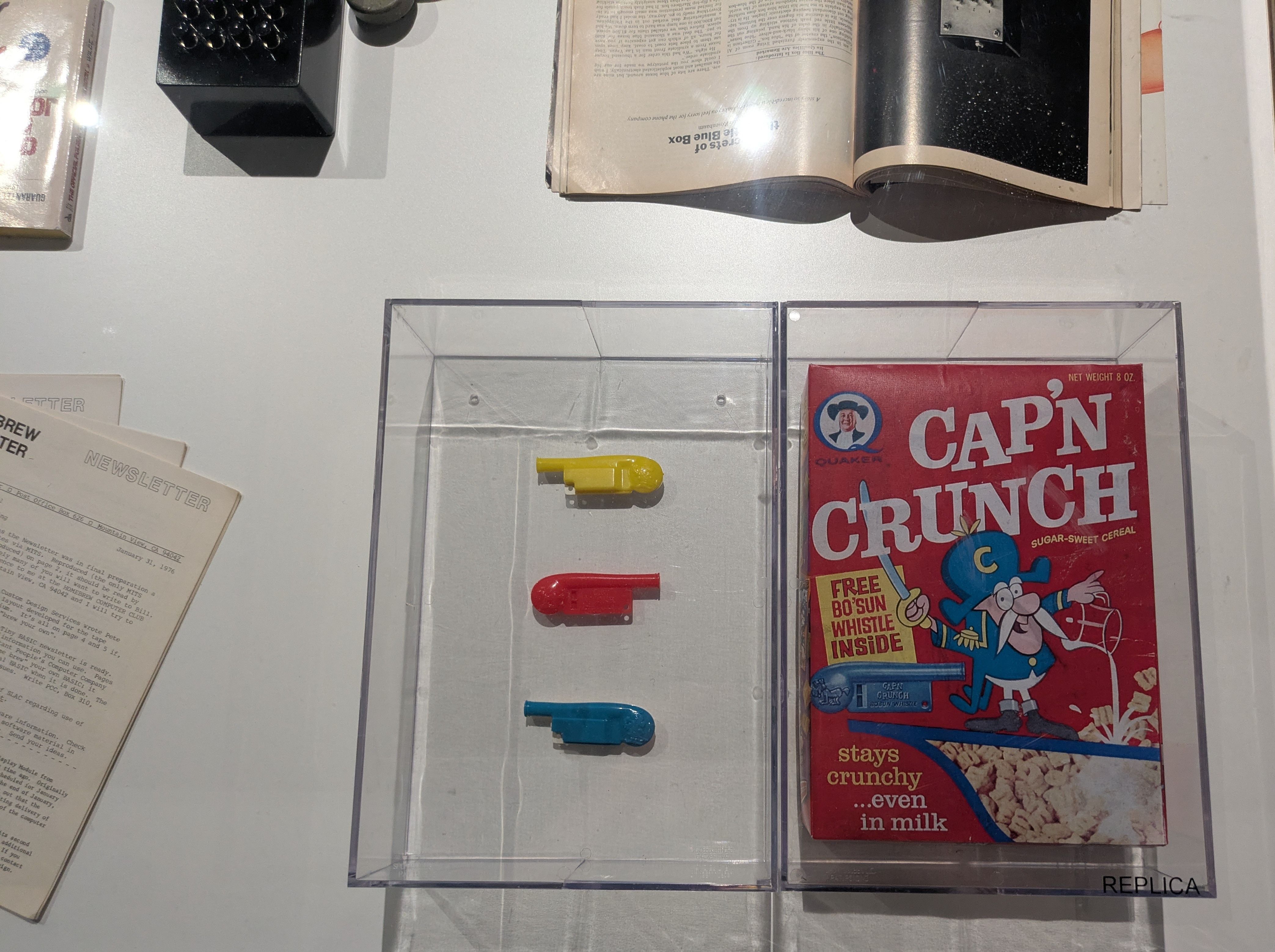 A Cap’n Crunch box reproduction from the era next to some of the whistles which will no longer give you free calls. | 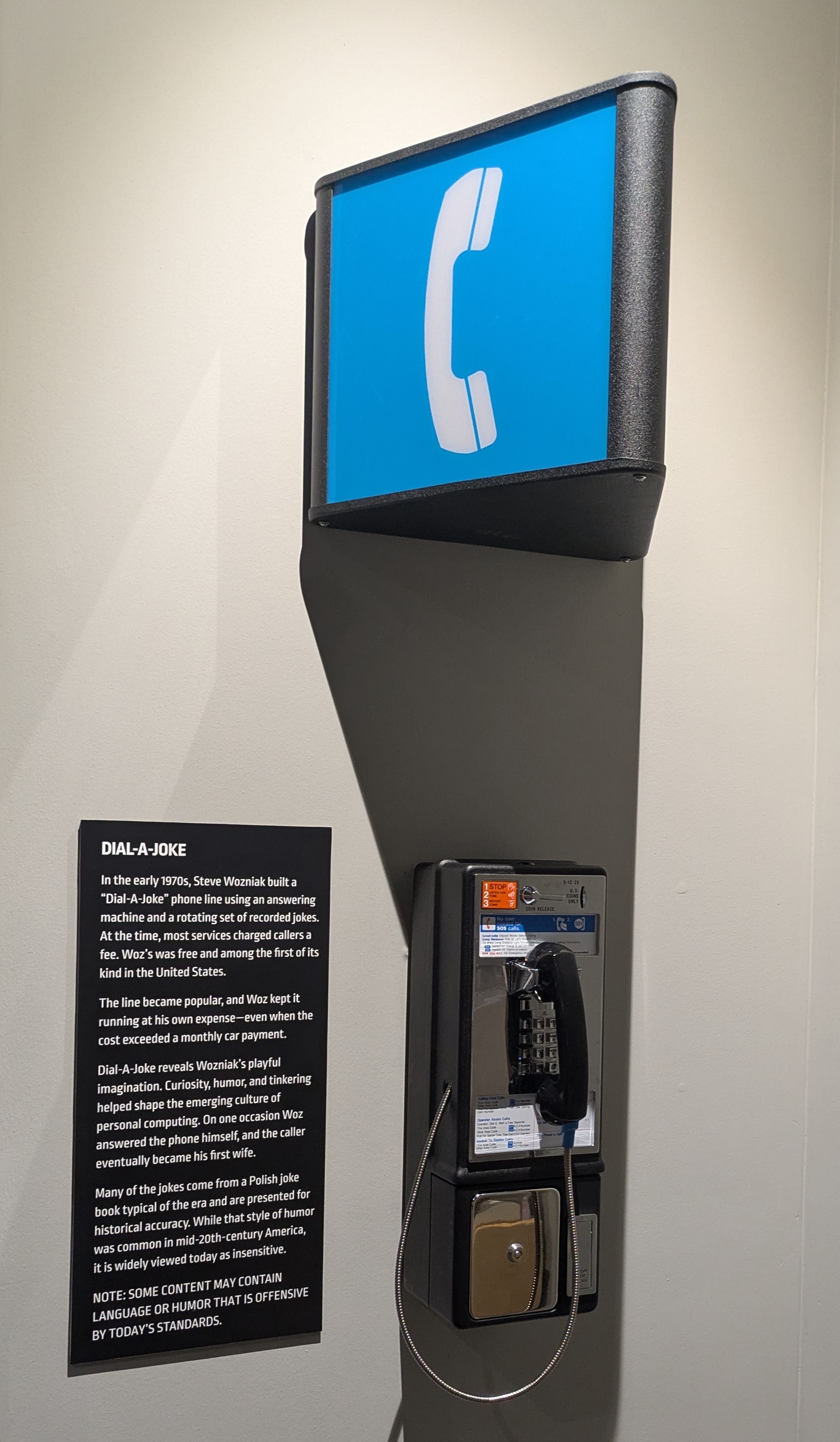 A payphone that will play back one of Wozniak’s recorded jokes from his joke line. Want another? Just give it a quick hook flash! |
There are writers whose whole thing is diving into topics like this, such as Computers Are Bad, and I highly recommend checking them out for deeper dives into these topics. What you need to know is, in the era of payphones, they needed a way to communicate with the rest of the telephone network. They didn’t just have to relay a phone number to dial, but also things like how many coins were dropped in the slot. This was especially important for operator-assisted long distance calls. It was common to use in-band signaling, or sending signals over the same wires that you used to talk. There’s a lot more to this, and the ways they tried to combat phreakers, but in essence: if you could find the right signals, and get them into the right channel, you could make the central office think the phone did anything the phone was capable of doing.
There’s so much more, such as phreaking PBXs, that I simply don’t have the time to cover. Suffice it to say, this was a popular activity for the curious. Those with perfect pitch could replicate the necessary sounds at the right frequencies, and the field also attracted many blind folks. Most of these tricks were all sound-based, and they unlocked audio communications channels. Captain Crunch cereal released a toy in every box (another bygone practice), a whistle, which just so happened to be tuned to 2600Hz—the pitch of a coin drop3 . Conspiracy theories arose, and one phreaker even took the name Captain Crunch4 . Eventually “boxing” became a thing, which didn’t involve punches but did involve building devices that could emulate certain sets of abilities or manipulate certain parts of systems (primarily phone systems) to some benefit. The blue box generated various tones to manipulate the phone system, and was a popular hobbyist build. Wozniak designed and built one. He also ran a joke hotline that would answer the phone when dialed and play back a pre-recorded joke5 . It was really neat to see so much context for the era that gave us the Apple 1. And hoo boy, it wasn’t just the Steves that gave us the Apple 1s. The Mimms Museum delivered as well:
Apple 1 … times four!
The Mimms Museum is displaying The Ohio Board, the Huston Brothers 1, the Burch, and the Baum6 . These boards are early batches, including serial number 13 and another signed by Wozniak. One board was sold and exchanged as part of an Apple II trade-up program. Cliff Huston noticed the pile of boards in Steve Jobs’ office, destined for scrap. He took two, one for him and one for his brother, and you can see one of them here today.
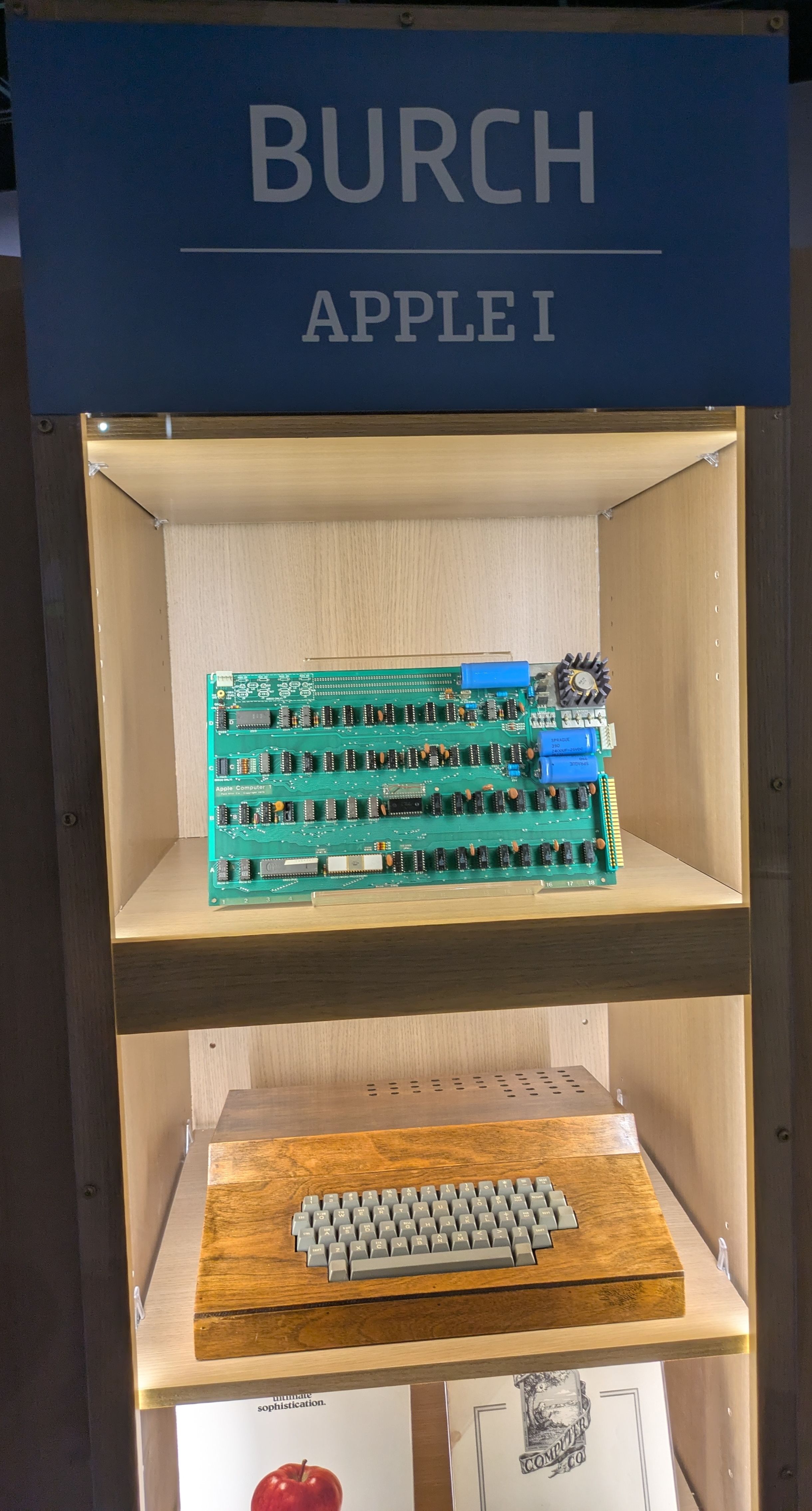 The Apple I Burch, for sure. The mainboard is set aside from the original wooden case it lived in. | 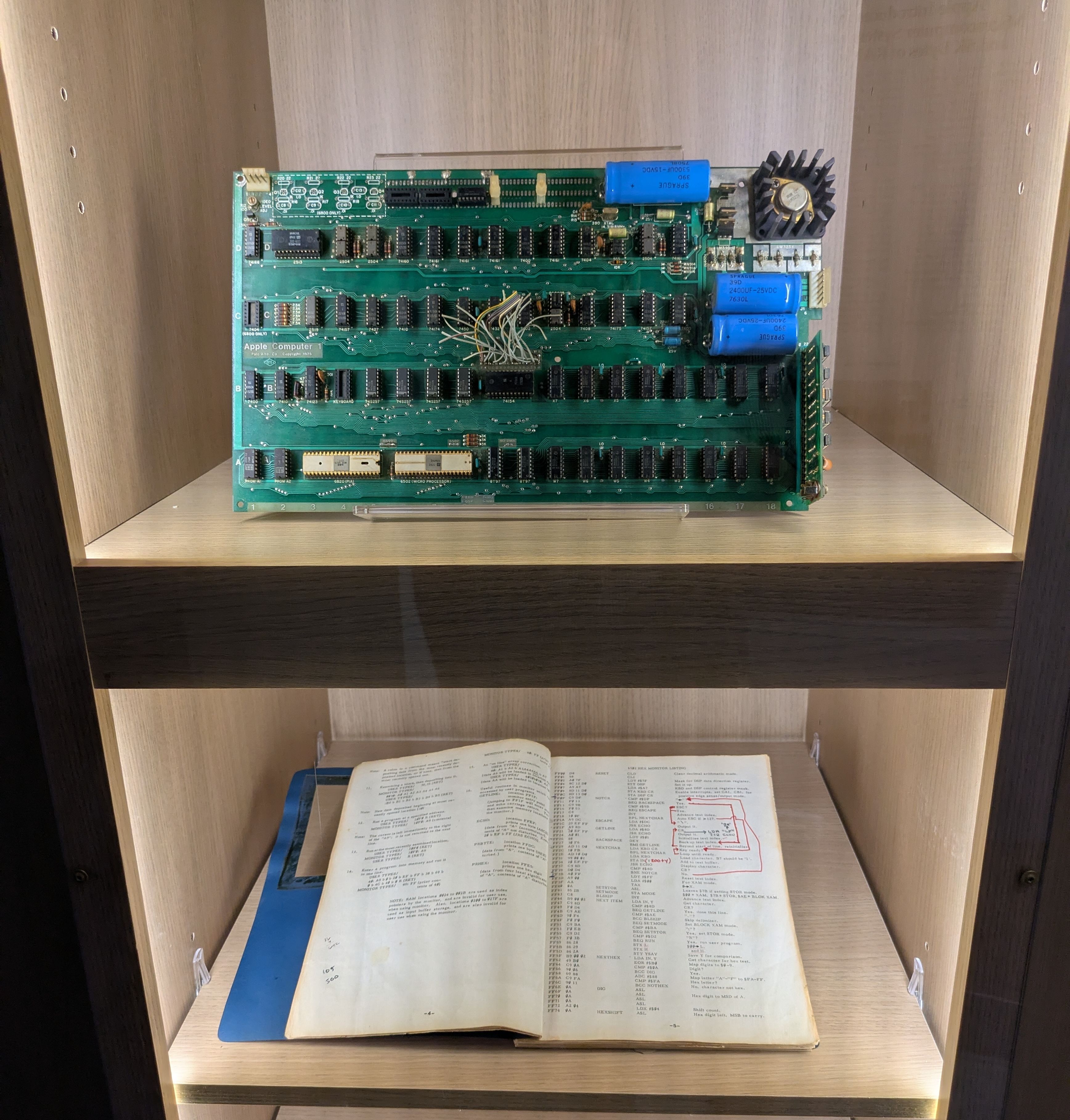 I believe this is one of the two Huston Brother boards. This was literally saved from a trade-in scrap pile from Jobs’ office floor. |
These were all working machines, some in their original wooden case. This part of the museum is an opportunity to see some really unique pieces of computing history. They are also very generous in their description of the machine, which works really well for a kit computer. The components are discrete elements, and you can physically see the different parts of the machine and how they interconnect. These machines still worked at a scale where you could visually break down much of what’s going on, as opposed to modern system on chip devices. This is a terrible way to, say, build a smartphone/pocket computer, but it’s very instructional if you want to dig into what’s going on under the hood (or replace failing parts).
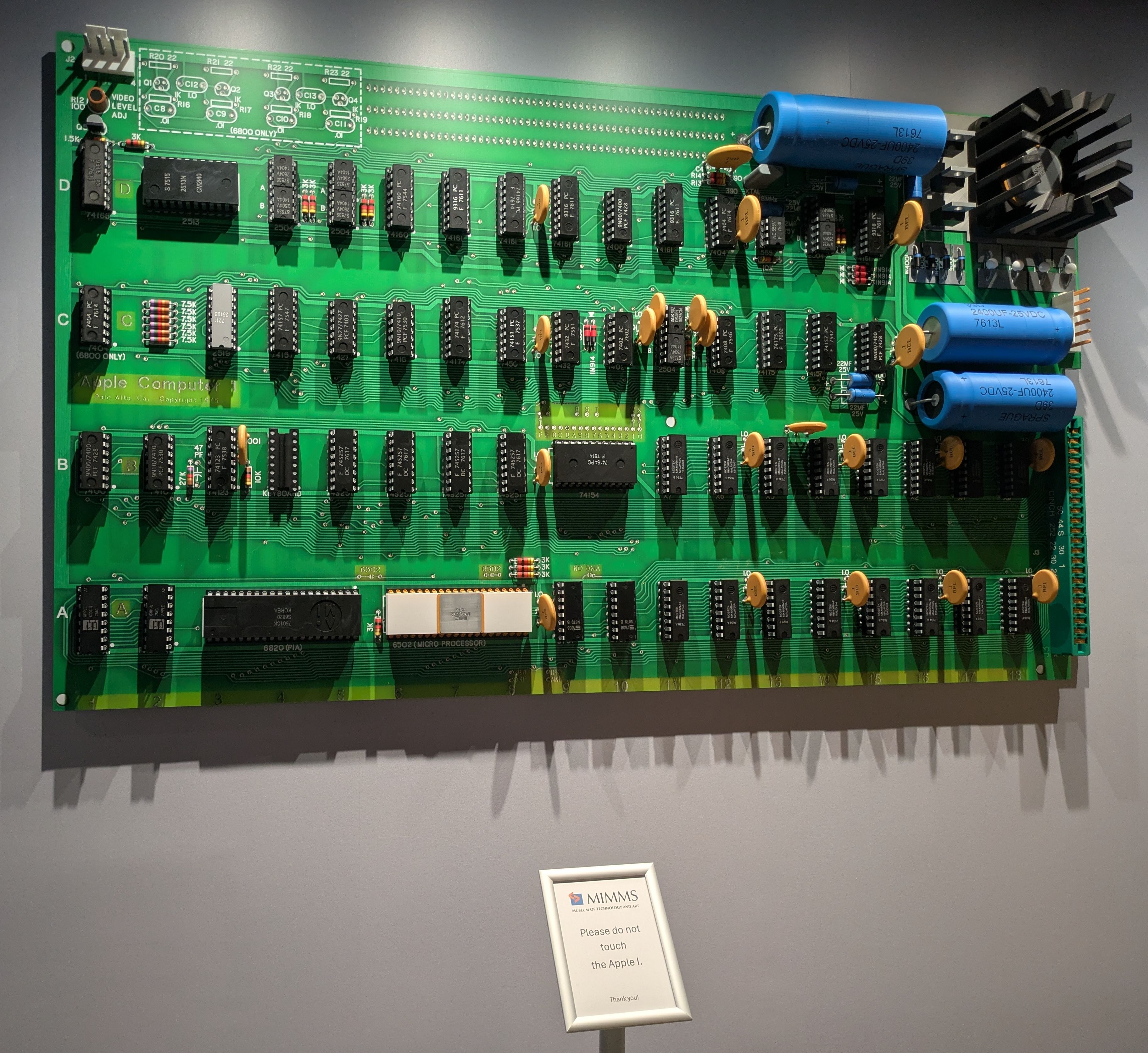 A super-sized version of the Apple I mainboard. No, it doesn’t work. 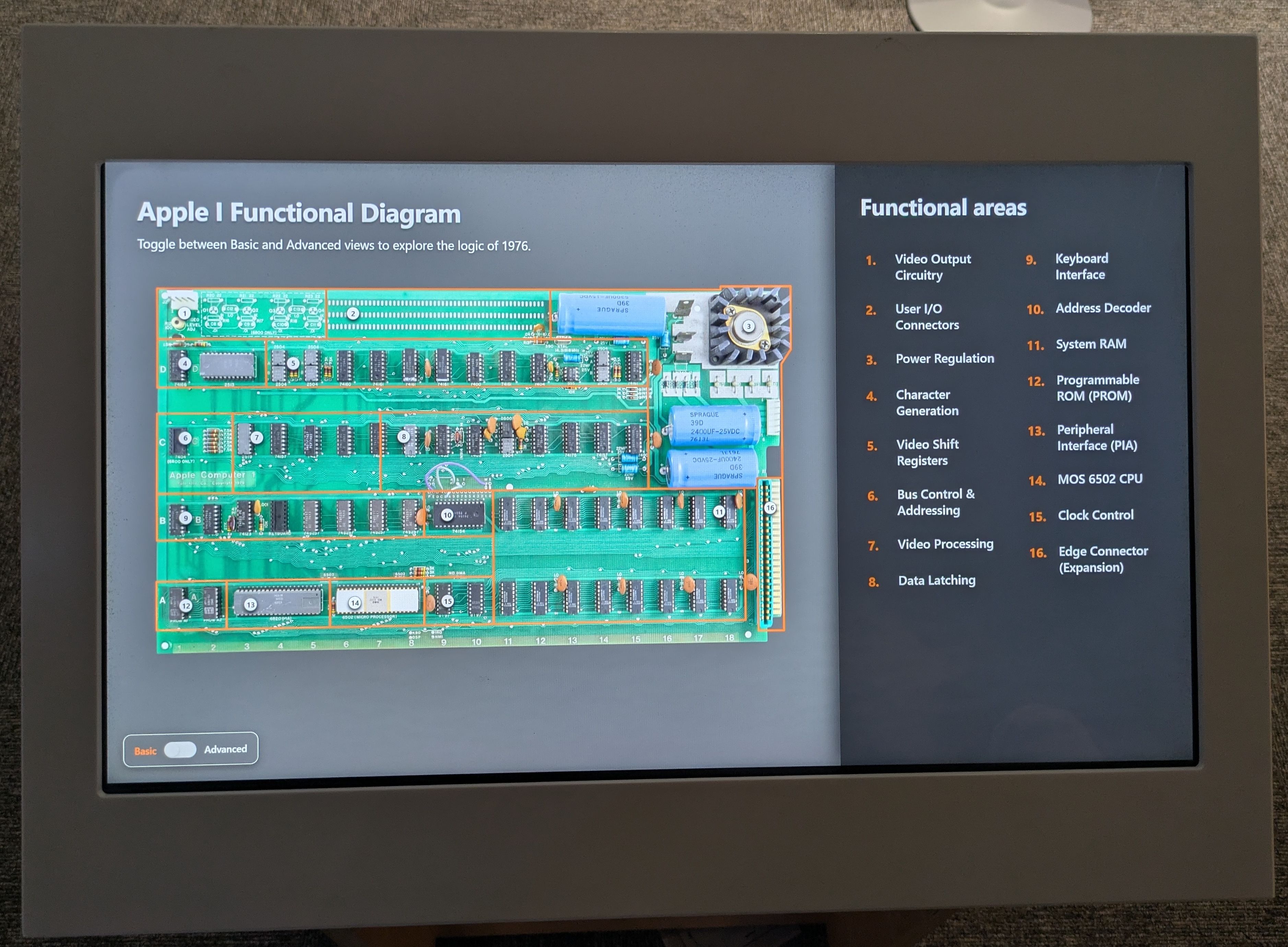 An interactive display of the Apple I Mainboard, with very helpful descriptions of each section’s function. | 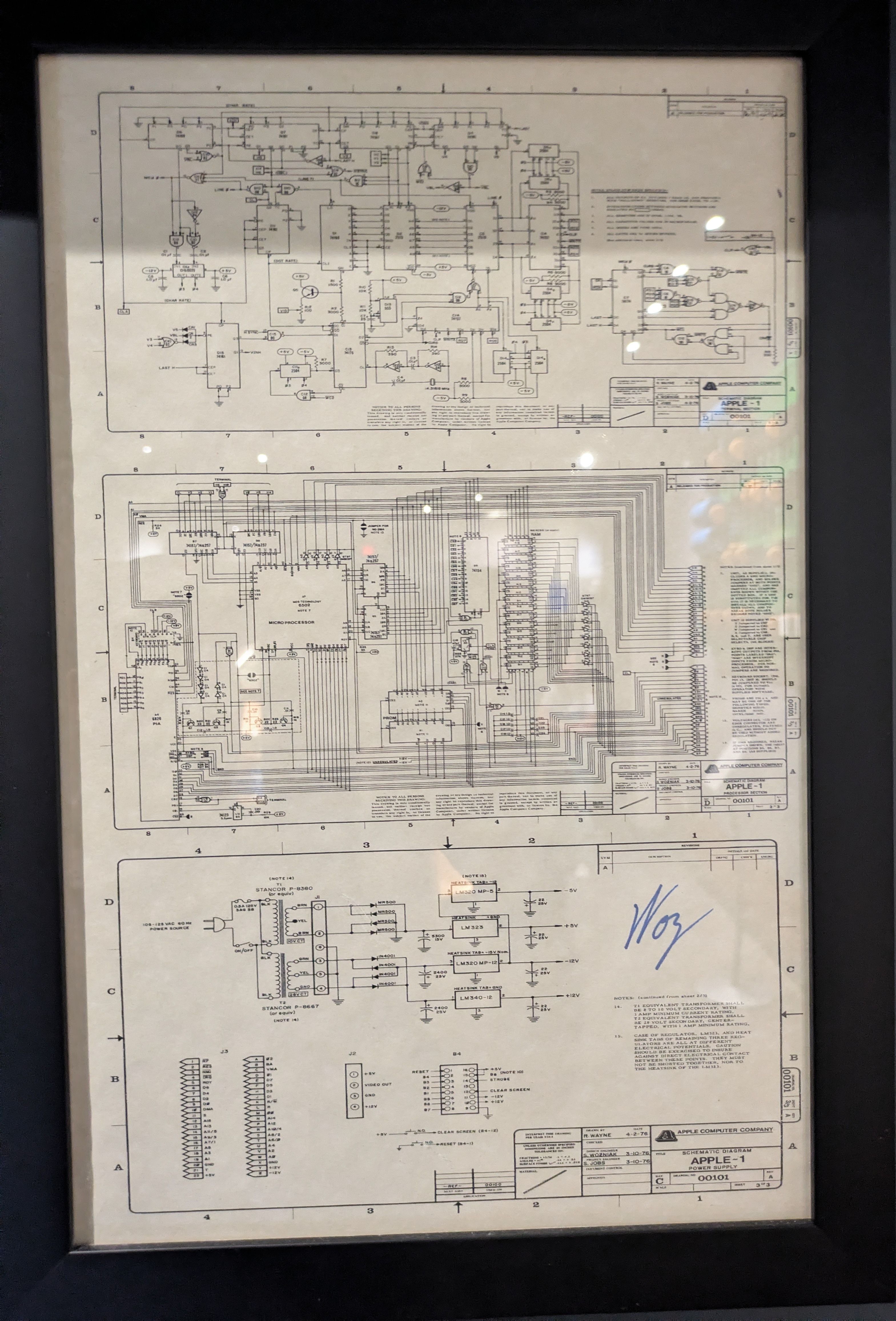 A schematic covering the construction of the Apple I mainboard. Definitely one of the nerdier things to look at. |
At the heart of the Apple 1 was the MOS Technologies 6502. A few years earlier in 1971, Intel brought to market the Intel 4004. This was the first clear mass-market microprocessor, serving as a marker for the industry’s crossing into Large Scale Integration (LSI). Various technological improvements, including the ability to scale Metal-Oxide-Semiconductor Field-Effect Transistor (MOSFET) production, allowed manufacturers to deliver sufficient transistor count and density to achieve scalable CPU production. Intel continued with these successes, and less than a decade later launched the 8086 in 1978. If you’ve ever heard of “the x86 architecture”, which is still around and in popular use today, the 8086 (a 16-bit processor) is where that all started, and yes, your modern day x86 architecture processor is largely still backwards compatible with the instruction set…though you won’t be running 8086 code in Windows. It’s…more complicated than that, for several reasons.
There are many people responsible for Intel’s rapid acceleration in the 70s, but one I want to point out in particular is Federico Faggin. I point him out not just because he has a legitimate big hand in the birth of the modern computing era, but because he also has a really good book and is very generous in his recollection of his time at Intel. Check out Silicon for all kinds of details, including a dive into his patented work as an appendix.
Federico ran into disputes with Intel on hwo to prioritize development on the 8008 specifically and the 8000 series in general, and ended up co-founding his own company, Zilog. The Zilog Z80, an 8 bit microprossesor, was released in 1976, two years after Intel launched their 8080. The Z80 was binary compatible with programs writtern for the 8080, so you didn’t have to buy all new software, and it had some integration improvements and a deeper instruction set with a second set of registers. It was also cheaper, generally, breaking into a market dominated by Intel.
The MOS Technologies 6502 sat smack-dab in the middle, released in 1975. It was able to take advantage of improvements such as NMOS (n-channel Metal-Oxide-Semiconductors) to reduce cost, and this chip was by several times the cheapest 8 bit CPU on the market that year. It did not copy Intel’s instruction set, which was a bit of a challenge in selling the computer: any software you had that would run on an Intel system would not run on the 6502. You’d have to buy it again, provided there was even a copy available that would run on the chip. That didn’t bother hobbyists, though, who wanted to experiment, build their own hardware, write their own software. It’s affordability made it popular with kit builders, which is how it got into the Apple 1. The 6502 and the Z80, amongst others, provided some mid-decade pressure on Intel to focus on chip cost and performance. Intel is huge today, Zilog is still around mainly in the System on Chip (SOC) space. MOS Technologies was bought by Commodore after they saw what the 6502 could do and how popular it was.
Exhibits
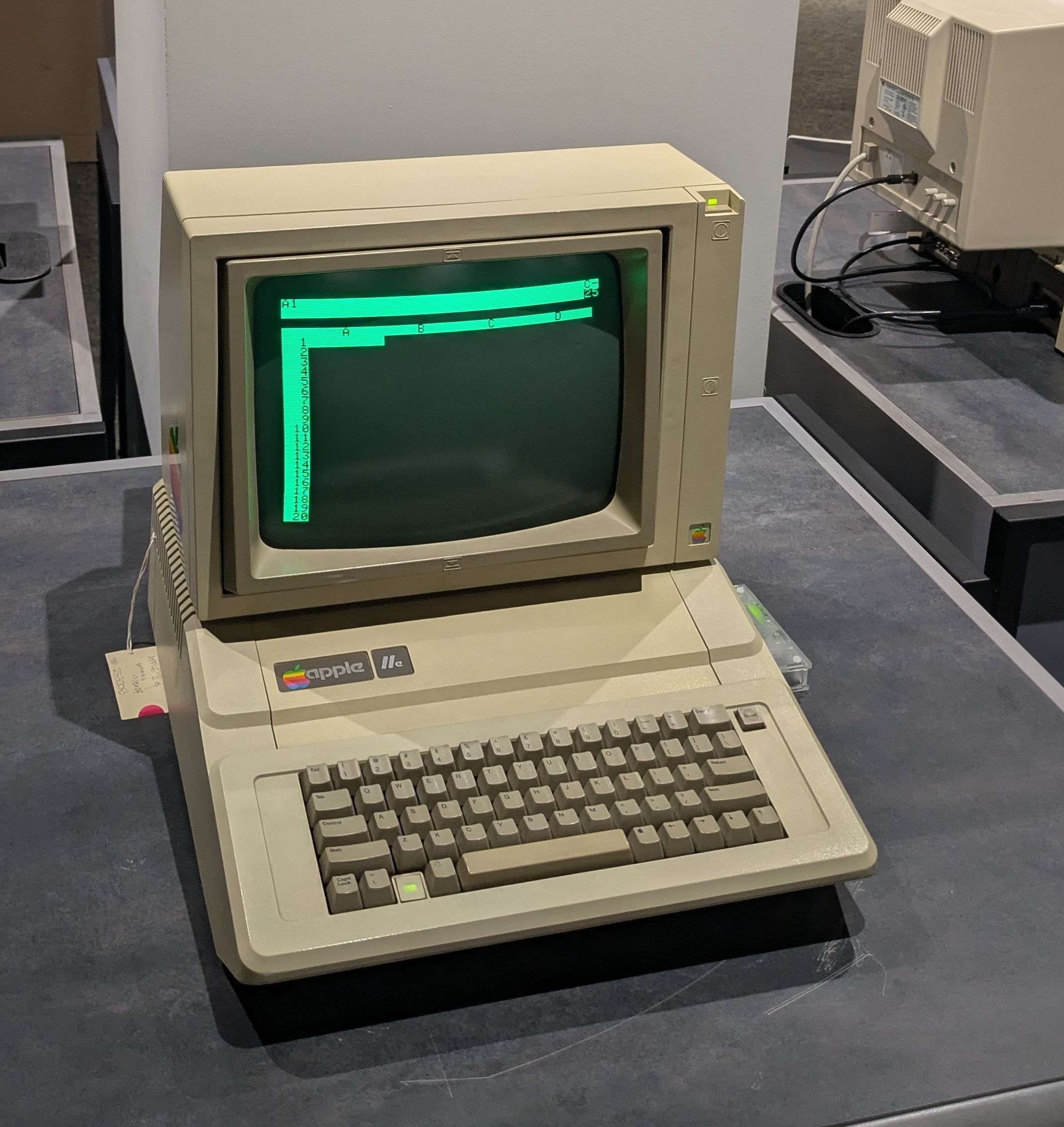 Apple 2e installation of Visicalc. If you’re an Excel fan, this is basically where it started. Sadly, none of the Apple 1s are up and running, but they do have Apple 2es running various pieces of software that famously ran on the system. You can play Zork, you can use Excel Visicalc. They even have some early Macintoshes up and running for fun. | 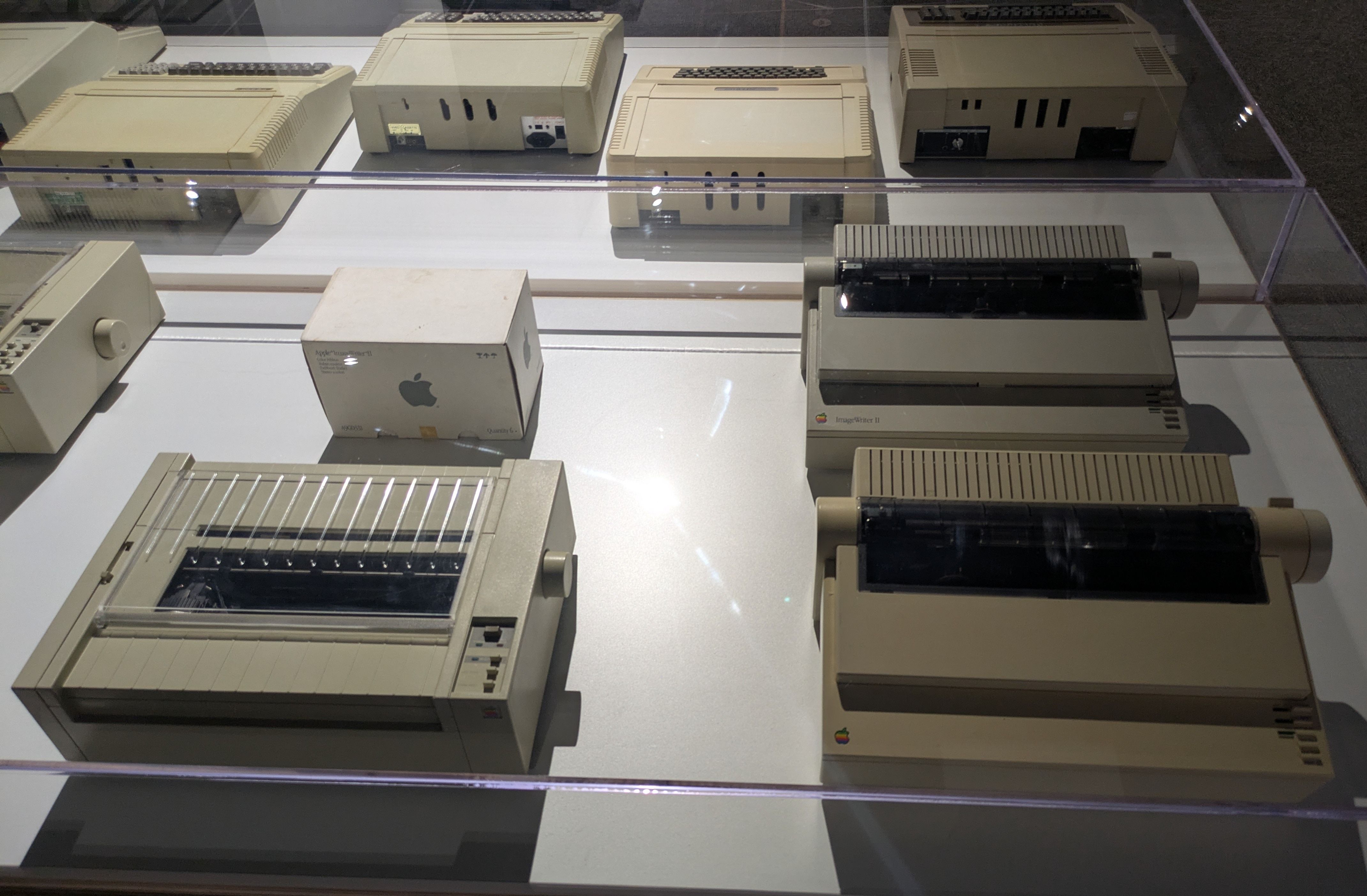 A collection of various types of old printers. I can hear this picture. 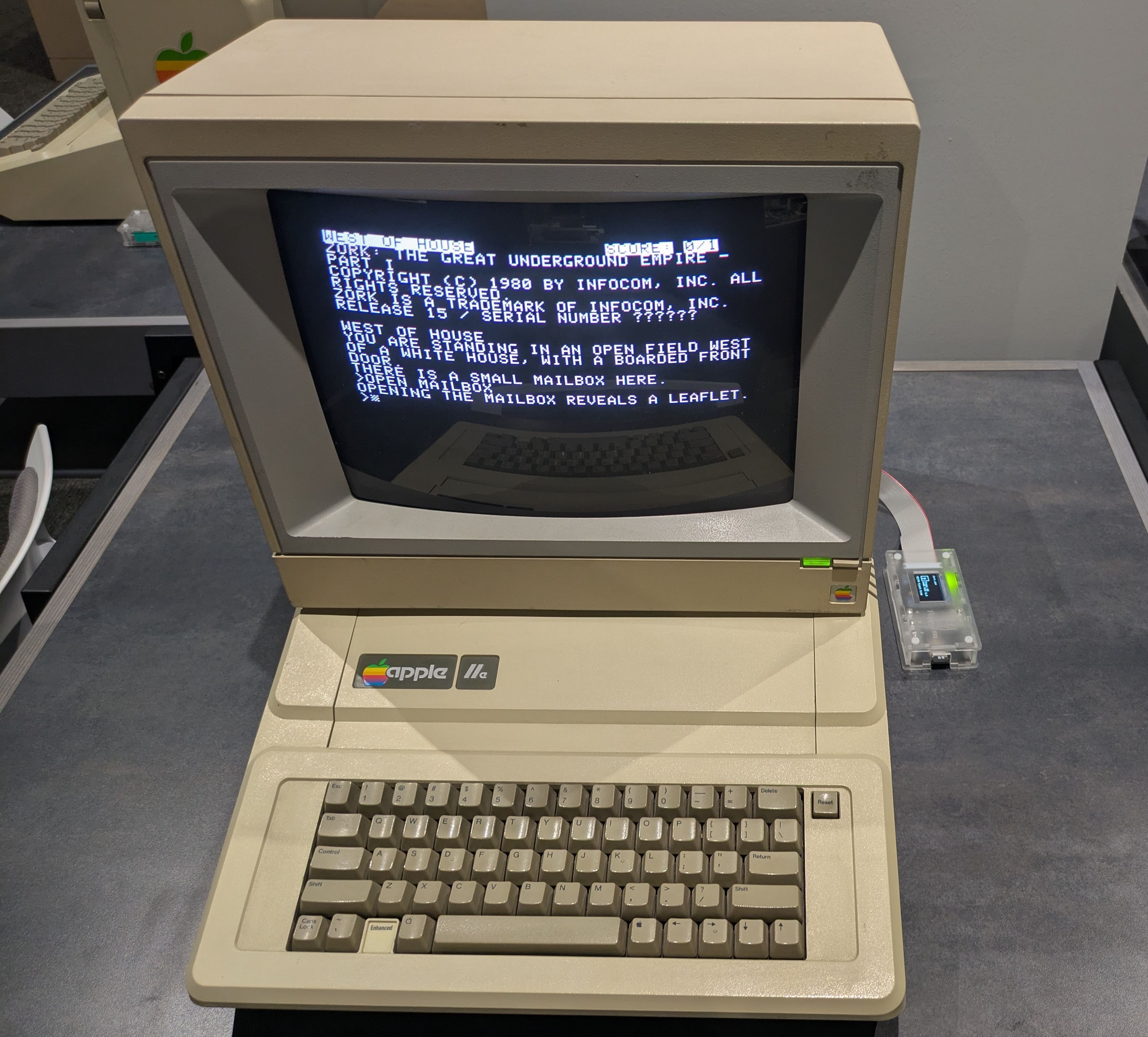 Zork running on an Apple IIe. Get ye flask! |
You can walk through the timeline of history and see all kinds of machines, including early Apple digital cameras. They have a wall full of iMacs with projection-mapped media, and a timeline of iPods. There’s a few interactive elements in this part of the exhibit, though we’ve moved on towards the modern computing era and you’re not going to be putting hands on as many Apple devices directly as much as you’ll be interacting with other kinds of systems, like a gesture recognition trivia game.
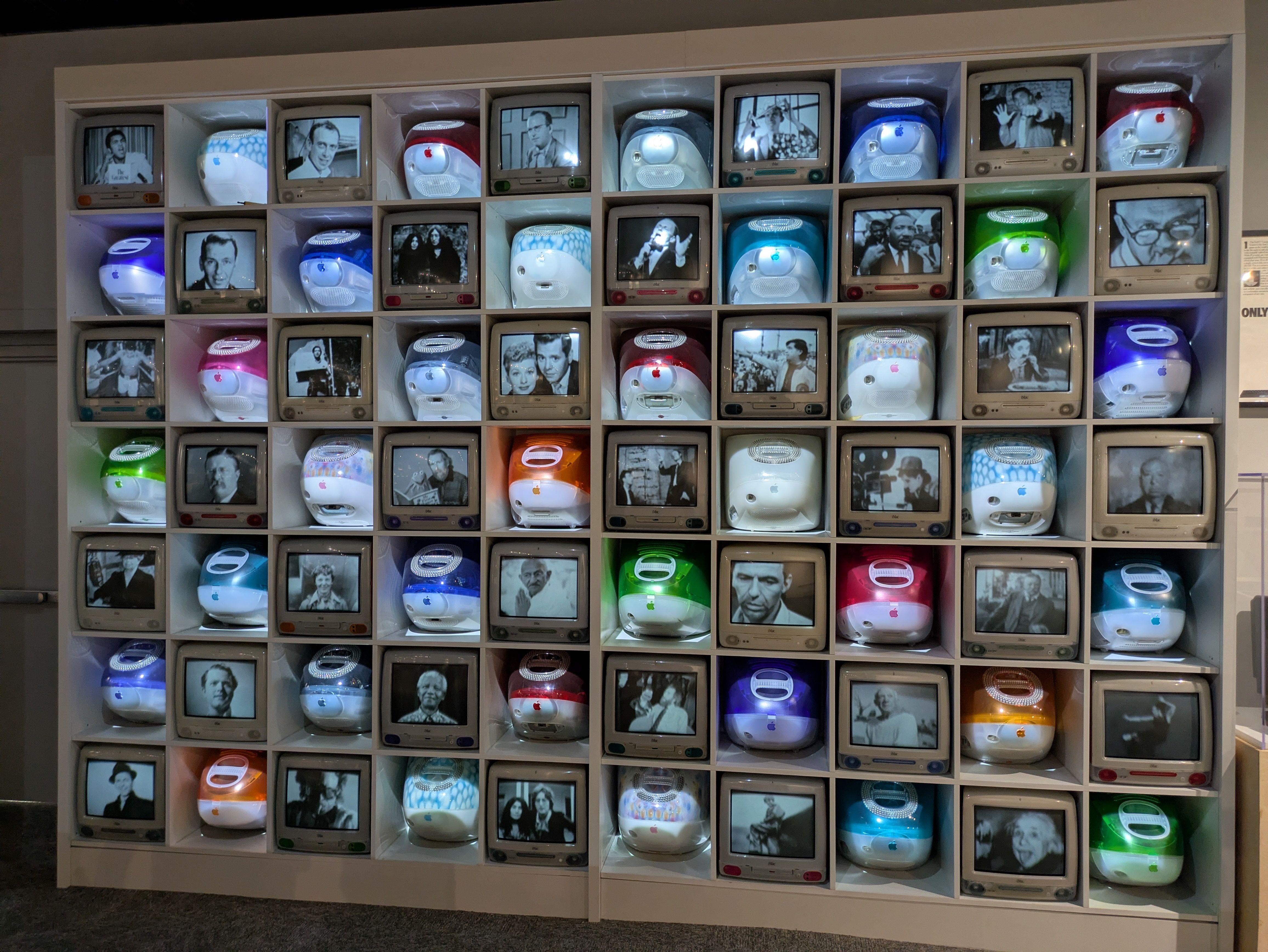 A wall of iMacs. They are not running pictures, but decorated with a clever use of projection mapping. | 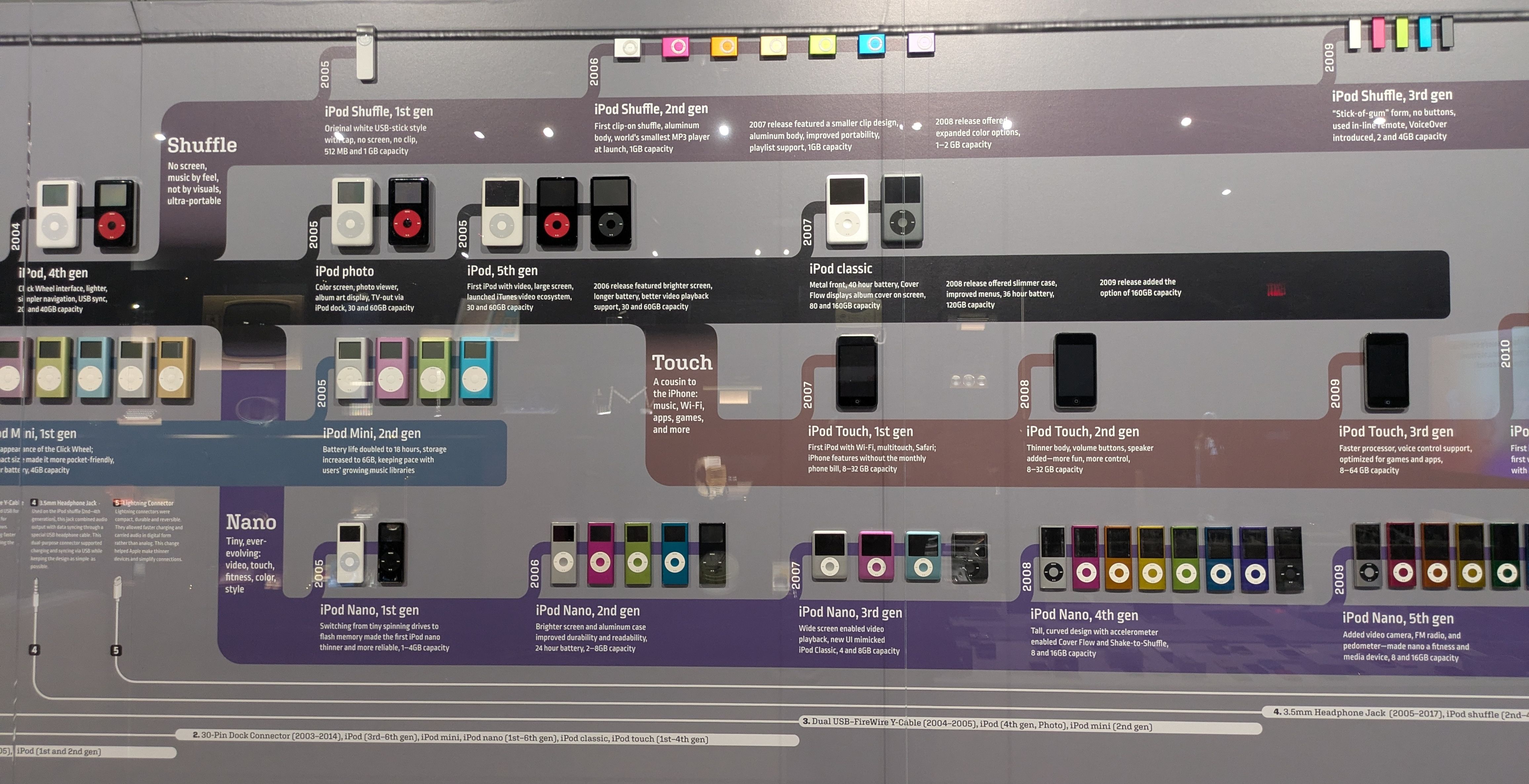 The iPod timeline, complete with examples from each generation. |
The final room has a whole bunch of interactive pieces. The exhibit was still in preview when I went, and they were in various states of function, but it looked really cool. I think anyone would have fun, but it seemed like it would be a nice bonus for parents whose kids made their way through the rest. There’s some good interactive things along the way, but this is like a touch-all-the-things jackpot at the end. A nice reward for not complaining about being “bOoOoOoRrReDd” too much.
Plus, if you play your cards right kiddos, there’s a mini golf course right next door! If that’s your thing, make time for the two 18-hole mini golf courses at The Fringe. I’m more of a Mimms person, but mini golf is up there, and putting the two together makes for a fun and educational and fun day. If you need to bribe someone who’s more into fun than educational, I’m not going to judge.
An Easter Egg
There’s one thing in this exhibit that was really interesting to me…but possibly only caught my eye because of my recent trip to Hales Bar Dam and the rabbit hole I fell down writing about it. In 2010, Apple added the Cherokee syllabary to macOS and iOS. A syllabary is a transcription of a spoken language not by letters, but by sounds—syllables, or often even smaller chunks of words. If you’re familiar with languages like Japanese, you’re familiar with languages with syllabaries. They tend to have more characters, which makes the needs of a keyboard a bit different, and the example they show (below) is a pretty sad adaption compared to, for example, the options Android affords. I don’t know if the image the Mimms Museum presented is the actual keyboard (seems unlikely given the coloration) and 2010 is a while ago, improvements may have been made, but hey…representation!
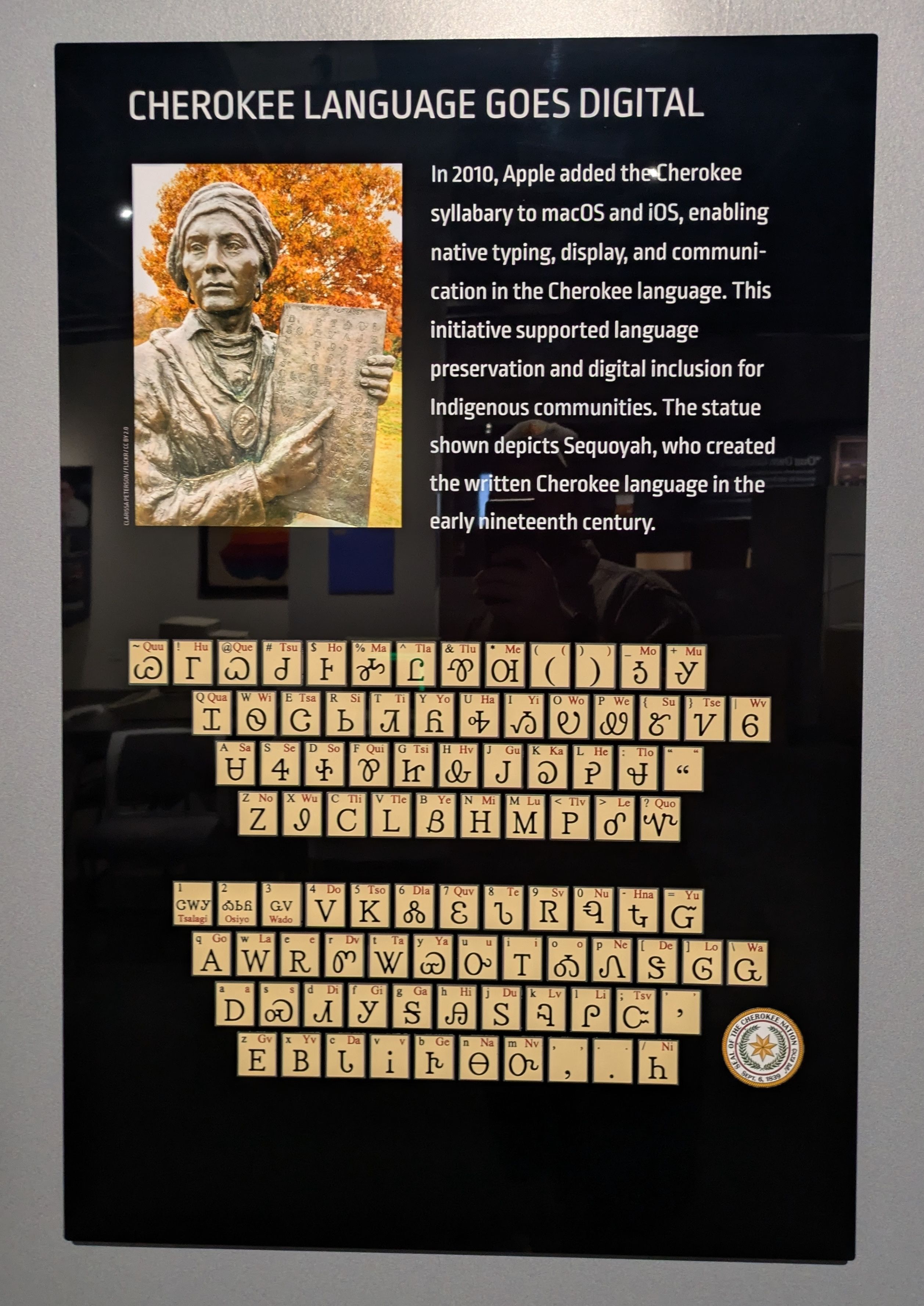 A display showing a sample Cherokee language keyboard and its place in macOS and iOS. | The real interesting part here is, Cherokee was not a written language for most of its history. Cherokee is7 a Southern dialect of Iroquoian, diverging about 2,000 B.C.E.8 It was a spoken language until Sequoyah saw European books in 1809 and was fascinated. He called them “talking leaves”, which is a beautiful way to put it. I wonder what he would have thought of Audubon’s The Birds of America (this was a few decades early) had he seen it. Anyway, Sequoyah set out to encode the Cherokee language. He started with a character per word in a logographic9 approach, but shifted to a syllabary. |
This is pretty clever—I don’t know what written languages he was exposed to, but what little I’ve seen is he was pointed to European books. I don’t believe either of these approaches would have been well, if at all, represented in the materials he saw. This was a neat bit of creativity.
Sequoyah also went by the name George as well: Guess, Guest, Giss are all transcriptions I’ve seen of his European last name. There are several suspicions who his father was, most point to a European of one of these names. He won’t enter the story much - he disappeared from Sequoyah’s life before he was born. His mother was Wut-teh, a Cherokee, and being a matrilineal culture that was the most important part for Sequoyah.
Sequoyah was at the interface of European colonization and Cherokee heritage, and his creation of the syllabary allowed for print media including at least one Cherokee newspaper. Funny enough, Nonie Webb had ads that Sequoyah took out in her work on Hales Bar Dam. I recognize that statue as soon as I saw it, with Sequoyah pointing to his work. There are only a few thousand speakers left today, which makes it really interesting to see the keyboard adopted by Apple, and to be able to tie some parts of history separated by almost 200 years together.
So go see things
Today it was driven back through my thick skull that one of the most important things you can do as a person is to go see things. Inquire. Dig in. No, this isn’t a “do your own research” screed—find some experts to put what you see in context. Expertise is a good thing! I glossed over a lot in this issue! People dedicate years of their lives studying things like this. People like Nonie Webb who gave a history of her region, Federico Faggin for his work on microprocessors, the staff at the Mimms Museum and the people they contacted. For some people, this is their lives, their history, their culture. I did not speak to any Cherokee people about their language, which could have been another good thing to dig into. At the end of the day, though, I’m telling you what I’ve seen, and I’m connecting a few random dots. I can’t cover it all.
Maybe I should have, though: for the Cherokee people, this is two hundred years of history built on top of four thousand years of language interwoven with colonization. It’s pretty wild to see how ideas can knit together. European colonization of the U.S. is filled with bad things done to Americans, including the Cherokee. I find it even more interesting, through that, we can still see how ordinary, every day people, can share ideas and grow in spite of how power wanted to break things apart. That’s now some perspective I have for the next Thing I See, and how I approach thinking about it.
Go see things. Learn things. Be open to ideas. The world’s too big, get at least some of it into your head. So much is connected, shaping the world you live in today. I appreciate you letting us connect over this silly ramblings around things I’ve seen. I hope it gives you some new threads to dive into yourself.
References
Federico Faggin, Silicon
The wonderful staff at the Mimms Museum of Art and Technology
The Computers are Bad blog
Always Wikipedia for fact-checking and such.
Thanks for joining me, where I’m one of today’s lucky 10,000! I hope you enjoyed it. Here’s all the beehiiv stuff that is required to be here.
— Lou
1 The 50th anniversary of the official Partnership, filed 1 April 1976, in California. The goal was to have a company to market and sell the Apple 1. The company was reorganized into a corporation in 1977, and the partnership (lower-case “p”) existed long before, so…these timelines can be kind of fuzzy!
2 Proving the computer you want is always $5000, another win for Machrone’s Law.
3 2600 is also THE hacker quarterly. Check them out!
4 John Draper, who we won’t talk much about. People have made statements about odd or inappropriate behavior since the 70s, and he’s been banned from at least 4 hacker computer security conventions including DEFCON and HOPE. 2600 puts on HOPE, showing we can’t even get one sentence away without some connection.
5 They were pulled from a book full of Polish jokes, which if you remember the 70s and 80s, they were everywhere. If you needed a butt for a joke, it was the venerable, stout Polish people who would bear the brunt of it. There’s a whole Wikipedia article, apparently it started earlier than that. Everyone’s got their problematic parts I suppose. I have no clue if Wozniak ever addressed that.
6 Yeah, they’re big enough deals to be named.
7 This has sources and Wikipedia has graciously summarized it as well, though I can’t really say if this is something we know from the speakers or from linguists who took it upon themselves to determine the history without consulting its speakers. I’ll admit I’m just spitting back the easy answer here.
8 It’s the only calendar I know. I’m sure they weren’t using it at that point though because nobody was using B.C.E. in 2000 B.C.E.
9 If you’re familiar with Japanese - Kanji! Other languages do this as well. “word drawings”, which is not nearly as neat as “talking leaves” but is admittedly a bit more specific on the implementation of a word being represented in whole by a symbol.